
Soccer at Home: Drills That Build Skills (and Connection)
You don’t need a full sized soccer field, fancy cones, or a coaching certification to help your child grow in soccer. In truth, the sport has been around in different variations over thousands of years and those things have never really been needed. My goal here, though, isn’t to deep dive a history lesson, but rather engage and fully reaffirm that some of the best development happens at home with minimal resources. It can be in the yard, the driveway, or even the living room (maybe… carefully… very carefully).
Whether you’re a parent who’s brand new to the game, a coach looking to give families extra tools, or just trying to keep your kids active, here are some easy, kid-approved ways to build confidence, coordination, and comfort on the ball without ever leaving home.
🏠 Bigger Picture: Why At-Home Soccer Matters More Than You Think
Kids improve the most when soccer becomes play, not pressure.
At home:
They’re relaxed.
They experiment more (and certainly don’t mind seeing us parents make our own silly mistakes).
They try things they’d never risk in front of a team.
And most importantly it’s precious time they are bonding with you.
As a coach (and a parent), I can promise you this: that small amount fun time at home each week does more for their skills and confidence than most families realize.
⚽Easy At-Home Drills (No Coaching Experience Needed)
1. “Gate Dribbling” Around the Yard
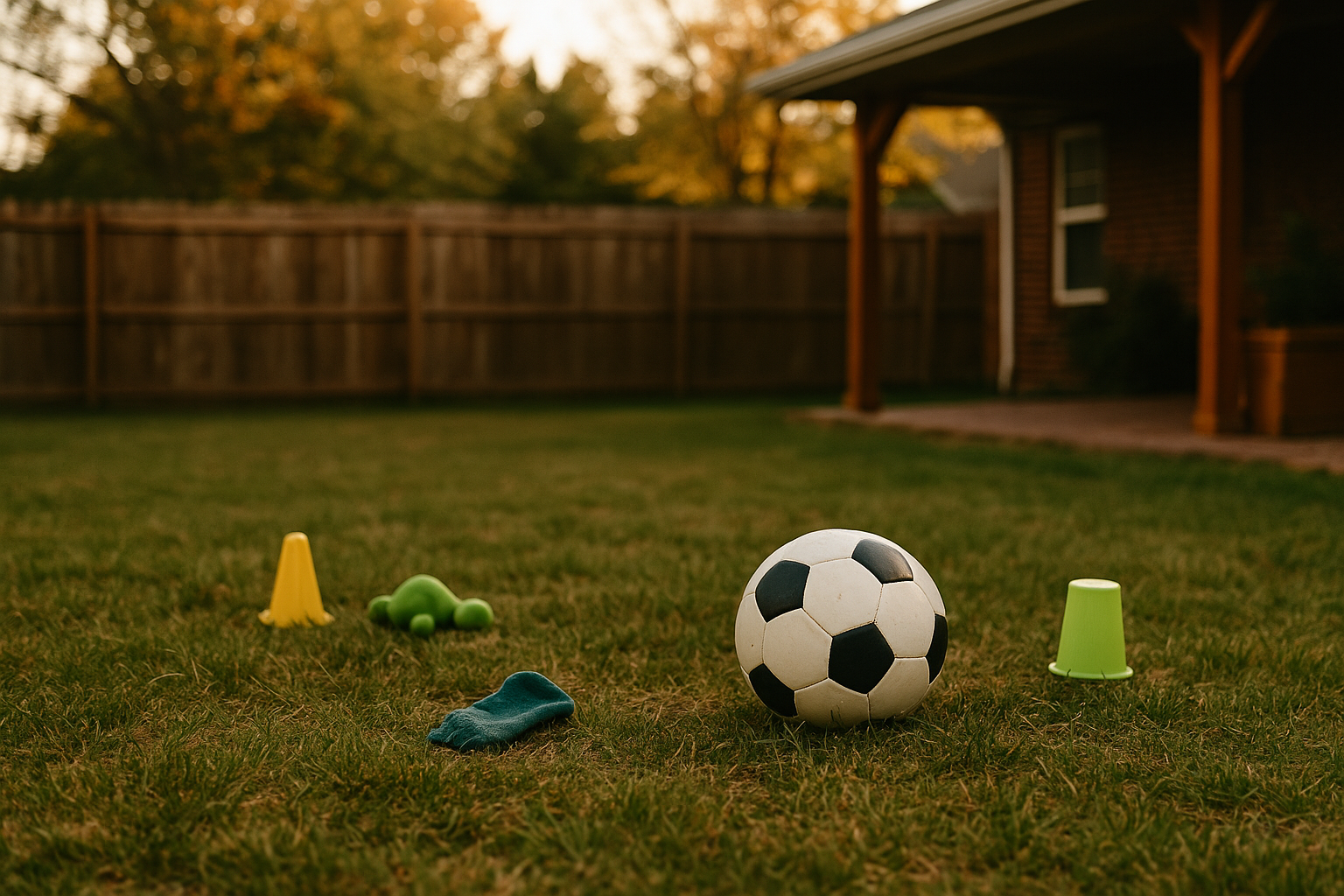
Best for: Ball control, soft touches
What you need: Two objects for a “gate” (shoes, socks, cups, toys — anything)
How it works:
Lay out 4–6 tiny “gates.” Have your child dribble through as many as possible in 30 seconds.
Add variations:
Only use the outside of the foot
Inside-of-the-foot taps
Stop-and-go changes of pace
Why it works: It builds agility and directional control without your child realizing they’re practicing a real technical skill. My kiddos especially love this and any of the drills when you also challenge them to do more than you can do. A little friendly competition between parent and child never hurt…right?
2. “Wall Ball” — The Perfect First Touch Trainer
Best for: Passing accuracy, receiving
What you need: A brick wall or solid surface (no garage doors unless you enjoy repairs). If you’re especially handy, an old bench, picnic table, or a couple of screwed together 2x4’s might even do the trick. Anything you can make a flat surface of that doesn’t move with each kick is ideal.
How it works:
Your child passes the ball against the “wall” and must control it cleanly on the return.
Progressions:
Two-touch (trap + pass)
One-touch
Strong/weak foot only (I prefer a “3 to 1” ratio on strong/weak foot - 3 on strong, 1 on weak in constant rotation)
Why it works: It teaches rhythm, timing, and the all-important first touch — one of the most valuable long-term soccer skills. More touches can be achieved through a simple 10-20 minutes of a wall ball session than a player can get all week at team practices.
3. “Treasure Hunt Dribbling” (Kids love this one)
Best for: Fun + footwork + direction changes
What you need: Small objects or toys
How it works:
Scatter “treasure” around your yard or living room. Each time your child dribbles to a treasure, they must pick it up, dribble it back to base, and go find another.
Optional twist: Add “lava zones” they have to avoid. (Old tarps or blankets work great for this too to section off large zones.)
Why it works: Kids forget they’re practicing and get carried away by the thrill of adventure. Again, you can challenge them to see who can collect the most treasure in a specified time window. Siblings can help instigate a good old fashioned rivalry here, too.
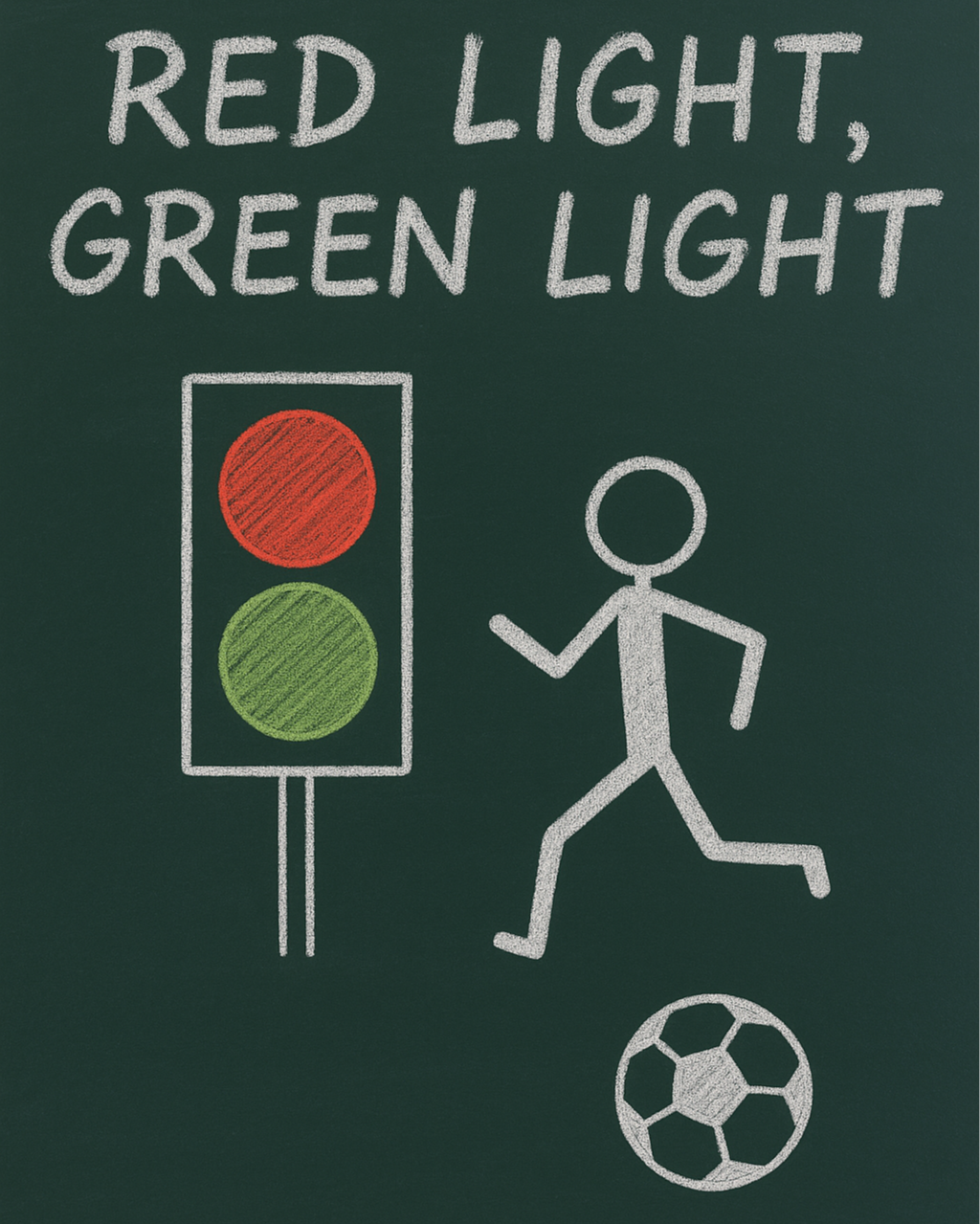
4. “Red Light, Green Light” — Soccer Edition
Best for: Coordination, control, listening
What you need: Just your voice
How it works:
Same concept as the classic game:
Green light: dribble forward
Red light: stop the ball and freeze
Yellow light: tiny, controlled touches
Blue light: turn around
Purple light: silly move
Why it works: Builds control, brakes, acceleration, and game awareness. Perfect for younger players and is a coveted game by coaches to help kids learn the basics.
5. “1v1 Shielding Game” (Great parent-kid bonding)
Best for: Strength, balance, protecting the ball
What you need: A small open space (outside usually works better on this one). I often use a simple blocking pad (like this one I purchased by GoSports) to help teach my kids and players while minimizing risk of injury.
How it works:
You gently try to steal the ball while your child protects it with their body.
Give them praise for:
Side stance
Using arms legally
Creating separation and turning away from pressure
Why it works: Kids rarely get taught shielding in earlier stages of their soccer career, but it’s one of the most empowering skills they can learn.
6. “The 5-Minute Touch Challenge”
Best for: Fast technical reps
What you need: A timer
Have your child do a rapid circuit:
Toe taps (30 seconds)
“Tick-tock” touches (inside of the feet - 30 seconds)
Speed-change touches (similar to the Tick-tocks but changing speeds at intervals - 30 seconds)
Pull backs (30 seconds)
Outside of the foot touches (30 seconds)
Short, simple, effective.
🌟 Tips to Help Parents (Even If You’ve Never Played Soccer)
✔️ You don’t have to “coach,” just participate
Your job doesn’t have to be focused on correct technique. It’s okay to guide them, but it’s vastly more important to just be present, positive, and encouraging.
✔️ Short sessions are best
Kids thrive in 10-15 minute chunks, not a full 45-minute training drill at home.
✔️ Follow their energy
Some days you’ll get 20 minutes. Other days, you might just get 2 minutes if they’re feeling burnt out. Both of these are still wins.
🙌 Final Thoughts
You don’t need a field, gear, or a coaching background to help your child grow. And soccer at home isn’t necessarily just about the drills. They’re tools and resources, sure. But ultimately it’s about the connection, the memories made (which may also be the accidental trauma bond of breaking of mom’s favorite vase), and the confidence built. Vases are replaceable. Time spent with our kids? Well…you get the idea.
