
Enzo Maresca’s Exit Won’t Fix Chelsea’s Real Problem: A System That Marginalizes the #9
The news of Enzo Maresca leaving Chelsea FC feels familiar. Not because of who’s departing, but because of what I feel it represents.
Another reset…
Another “new idea”…
Another promise that structure will finally replace chaos.
Now, obviously I’m not a Premier League coach, and I don’t pretend to see the game from the technical area at Stamford Bridge. But I am a soccer professional who has spent years studying structure, player roles, and tactical trends, while also being a lifelong Chelsea supporter who has watched this club evolve in real time.
That combination matters. Because when patterns repeat across managers, squads, and eras, they stop being about individuals and start being about ideas. What follows here in this article isn’t at all some claim of feigned superiority. It’s an informed observation rooted in experience, context, and long-term viewership.
A Quick Admission: The Lampard Era Still Lives Rent Free in My Head
Before going any further, I should admit a quiet bias of my own. I’ve always had a soft, if somewhat controversial, spot for the way club legend Frank Lampard’s Chelsea attacked and trusted youth. Not because it was flawless, but because it felt purposeful. It felt reinvigorated.
Players like Mason Mount, Reece James, and Tammy Abraham weren’t just filling minutes each week. They were given license and chances to develop within roles that demanded responsibility, connection, and central involvement. The football wasn’t always controlled or the prettiest, but it was honest.
That period matters to me. Not so much just as nostalgia, but as proof that Chelsea can build an attack around growth, cohesion, and central relationships when the system allows it to.
So with all of that pre-text out of the way, here’s what I feel to be the uncomfortable truth: managerial turnover isn’t Chelsea’s core issue. The deeper problem is that the system itself, regardless of who is implementing it, continues to emphasize wingers at the expense of meaningful striker involvement. Until that changes, no coach will solve the attacking inconsistency that has haunted the club since the departure of the likes of Diego Costa.
Managerial Turnover Is a Symptom, Not the Disease
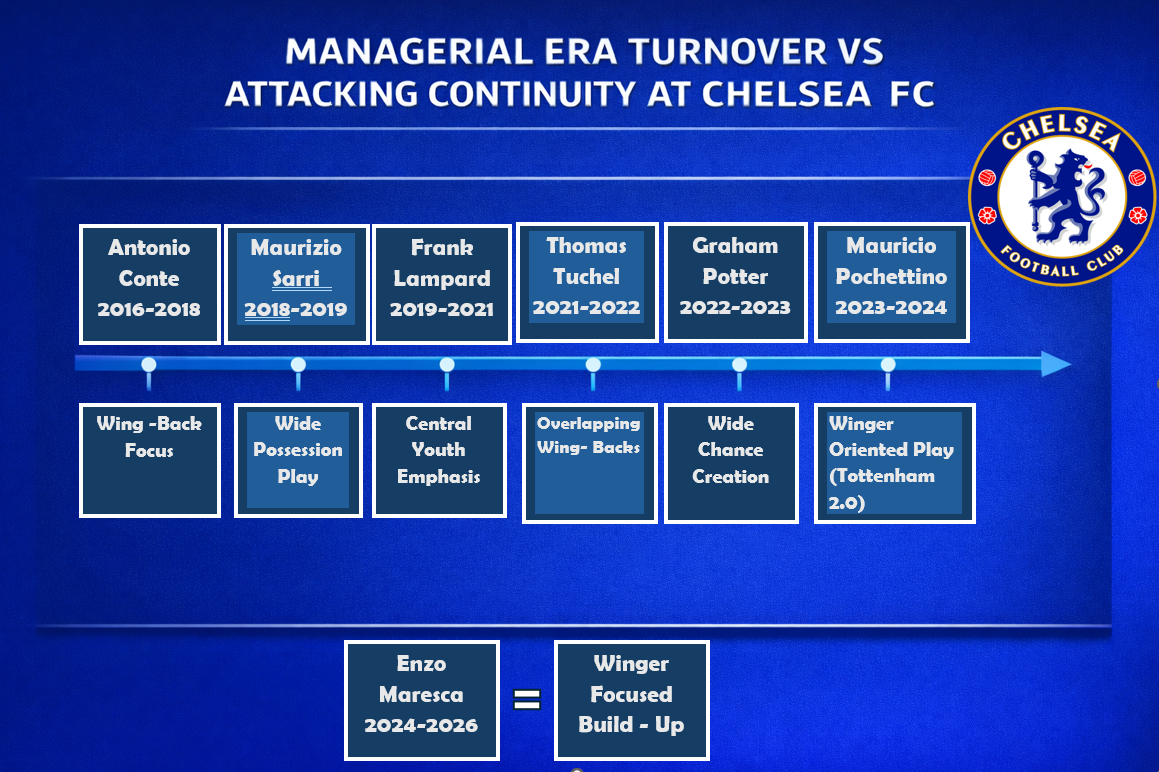
Chelsea’s post-Costa & Hazard era has been defined by the perpetual churn of players, managers, and “ideas” like a bad washing machine trying to bump out a fresh product. Tactical identities keep changing faster than the squad can internalize them, and each new manager is inheriting an attack that’s already conditioned to function without a central reference point. Sure, the club has Liam Delap and Joao Pedro currently. The quality and hype of whom I truly feel like are there…but without a design that includes their regular involvement, they’ll continue to fall short.
And the departure of Maresca fits the overall same pattern:
Short-term vision
Partial squad alignment
Tactical ideas that never fully root
Yet even during moments of relative structure, the attack defaults to the same habits: wide progression, an isolated striker, low central connectivity. This level of continuity across wildly different managers, should be an automatic give-away. Despite feeling like the team has success at times, it feels more like the idiom that “even a blind squirrel finds a nut from time to time.”
A System That Outlives the Manager
Tuning in to games, what’s striking to me is not how Chelsea attack under each coach, but how little it changes.
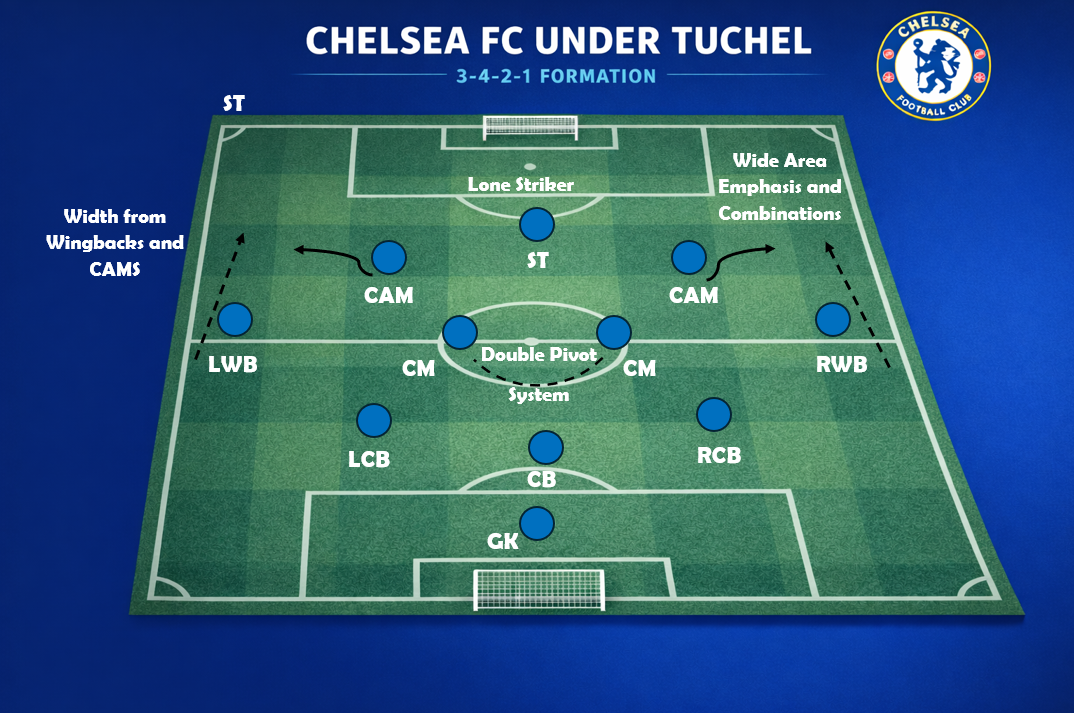
No matter the formations we’ve seen used… a 4-3-3 with Sarri, a 3-4-2-1 with Tuchel or Potter, or the inevitable fallback on the 4-2-3-1 by any of the club’s predecessors like Pochettino… the principles remain:
Width as the primary progression tool
Wingers tasked with chance creation
The #9 positioned high but rarely involved early
Central congestion without central solutions
By observation of Maresca’s style, he’s a positional-play focused coach , but even a good structured build-up philosophy of play collapses into the same endpoint: a winger forced to beat a defender with minimal central support.
Again…that wasn’t necessarily a Maresca problem. It’s a holistic Chelsea one. Perhaps even a fallacy of modern football styles, but that’s a broader debate for a different day.
Why Turnover Actually Reinforces the Winger Bias
Frequent managerial changes aren’t disrupting this issue, they’re entrenching it.
Here’s why:
Wingers are easier to plug into new systems - and I feel like you can see this easily from the sheer depth of A-list wingers we have at the club currently. (Garnacho, Estevao, Neto, Gittens all as dedicated wingers. With Palmer, Gusto, and George all shifting at times to also fill those wide spaces.)
Strikers require time, chemistry, and trust
Wide play offers immediate, visible “threat” even when inefficient
Coaches under pressure have a tendency to default to safer, wider patterns
When job security is fragile, risk shifts outward. Central combination play, with a #9 dropping, linking, and occasionally losing the ball, is seen as a liability rather than a necessity.
So what can we see? A system that ultimately protects itself, and a core striker presence that disappears.
The Cost of Excluding the #9 From Buildup
A striker used only as a finisher becomes predictable and easy to defend:
Center backs can hold their line
Opposition midfielders can crowd out the half-spaces
Wingers are forced to receive with back to goal or chase long balls in behind the fullbacks frequently
Chance quality deteriorates
This has been Chelsea’s attacking loop for years. The issue isn’t always just finishing efficiency. It’s chance creation architecture.
When the #9 isn’t allowed to:
Act as a pressure valve
Pin and manipulate center backs
Link play under stress
…the entire attacking structure narrows in possibility, even as it spreads wide in shape. I fear this has also led to unwarranted criticism of our #9’s and even looking at only the last 10 years, none of our top 5 goal scorers in that time were close to being a striker.
And wouldn’t you know it, Diego Costa still comes in at #6…also with 27. That number obviously doesn’t cover his whole career at the club. But for painting a picture of our highest goal scorers and contributors for the better part of the last decade, it’s quite telling where the focus is…and where it isn’t.
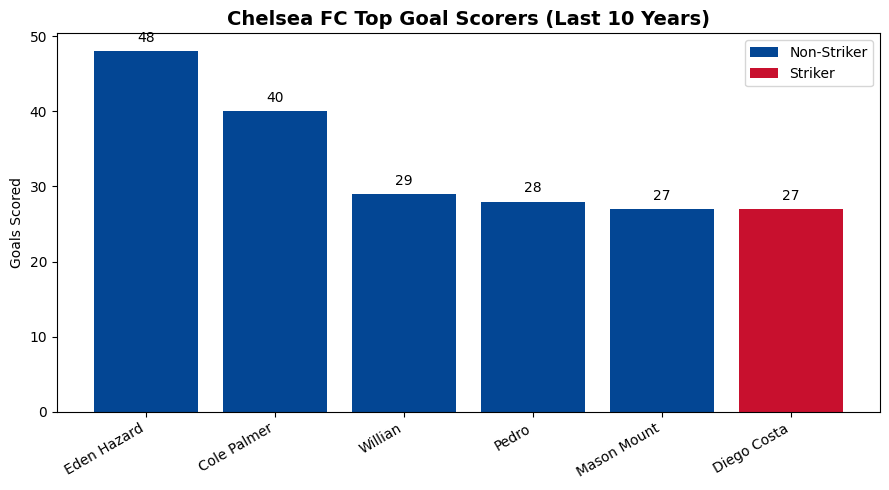
**Data metrics derived from statmuse.com. Totals reflect goals in the Premier League from the last 10 years of play only.
Maresca’s Exit Changes the Face—Not Principles
Chelsea can hire another progressive coach.
They can preach structure.
They can talk about patience.
But unless the club explicitly commits to a striker-inclusive model, one that prioritizes central gravity over wing dominance, I genuinely feel the outcome will remain the same.
The problem has survived Conte.
It survived Tuchel.
It survived Potter.
It survived Pochettino.
It’s survived every manager and interim patch in between. It stands to reason that this will also survive Maresca.
Final Thought
None of this is to suggest there’s a singular tactical fix or “one size fits all” answer waiting to be unlocked. Chelsea’s challenges are, and continue to be layered. The progress of which rarely follows a straight line, especially in a league that punishes instability as quickly as it does stagnation.
And maybe this interpretation proves wrong. Maybe the next iteration does finally unlock something different. But until Chelsea meaningfully reintegrate the striker into how they build, not just how they finish, it’s hard to ignore how familiar the patterns still feel. As the club enters yet another transition, the hope is that the next step forward isn’t simply another reset, but a genuine evolution. One that looks a little less to the wings, and a little more to the center. Preferably, with a sense of strong identity, combined with longevity on all fronts.
